> For the complete documentation index, see [llms.txt](https://taas-docs.stokr.io/llms.txt). Markdown versions of documentation pages are available by appending `.md` to page URLs; this page is available as [Markdown](https://taas-docs.stokr.io/asset-origination/examples-of-asset-structures.md).
# Examples of asset structures
How can you structure your issuance?
Depending on your use case, you can organize your assets in different ways. Here are common patterns and recommended setups:
## **Tokenized funds**
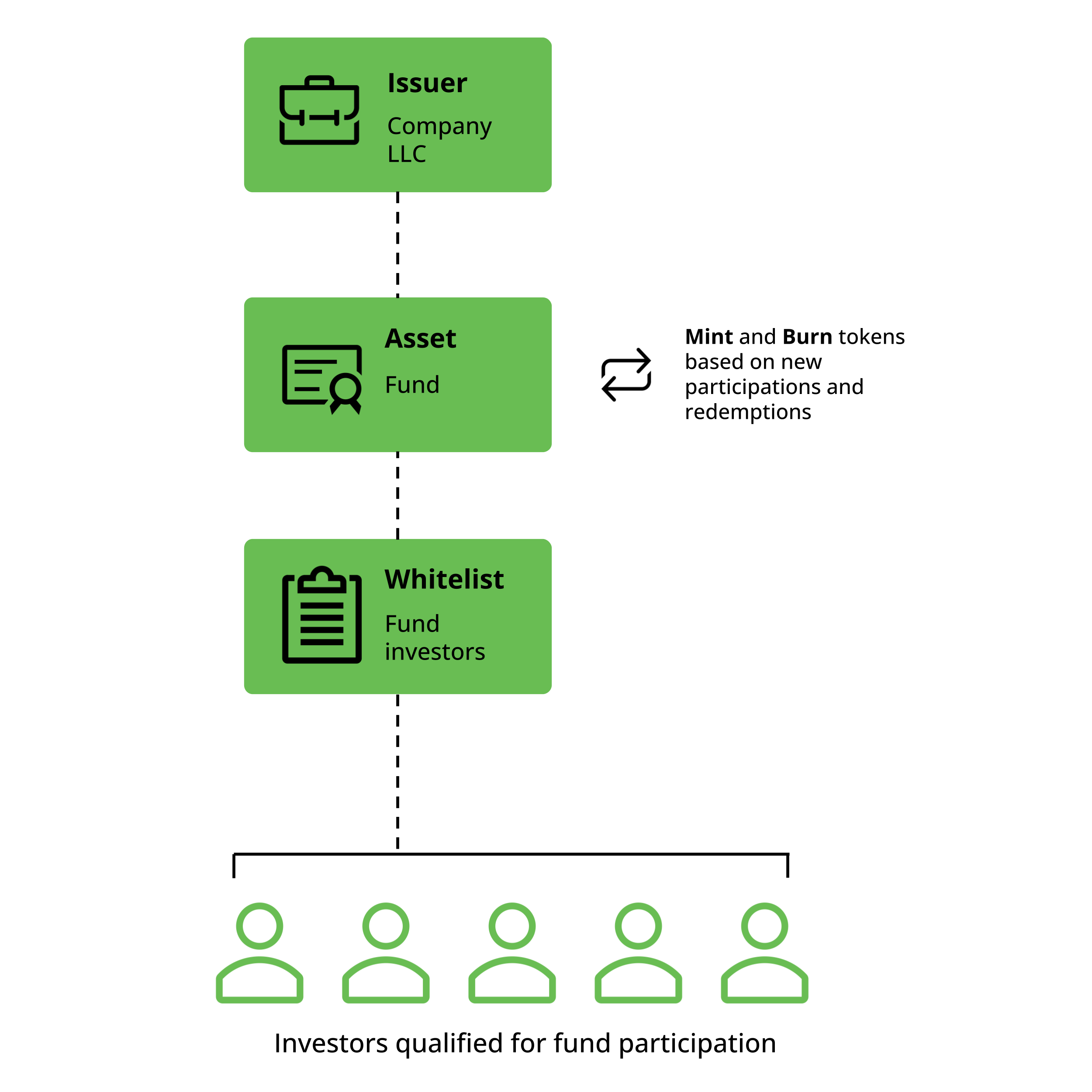
**When to use:** You're tokenizing a fund with variable token supply based on investor participation:
* Asset represents fund ownership
* Fixed investor criteria
* Token pool adjusts as investors buy or sell units
{% columns %}
{% column width="33.33333333333333%" %}
{% endcolumn %}
{% column width="66.66666666666667%" %}
**Recommended setup:** One issuer, one asset (the fund), one whitelist. Mint tokens when investors purchase units and burn tokens when they sell or redeem, adjusting the pool continuously based on investor activity.
{% endcolumn %}
{% endcolumns %}
## **Structured products with tranches**
**When to use:** You're issuing assets with multiple risk/return profiles, such as structured debt securities where:
* Each tranche has different investor criteria
* Each tranche has different conditions (e.g., interest rates, risk levels)
{% columns %}
{% column width="33.33333333333333%" %}
{% endcolumn %}
{% column width="66.66666666666667%" %}
**Recommended setup:** One issuer, multiple assets (one per tranche), with tailored whitelists. For example, if tranches range from low-risk to high-risk, create whitelists where high-risk includes only qualified investors, while low-risk includes those investors plus additional ones qualified for conservative investments.
{% endcolumn %}
{% endcolumns %}
## **Working capital for production batches**
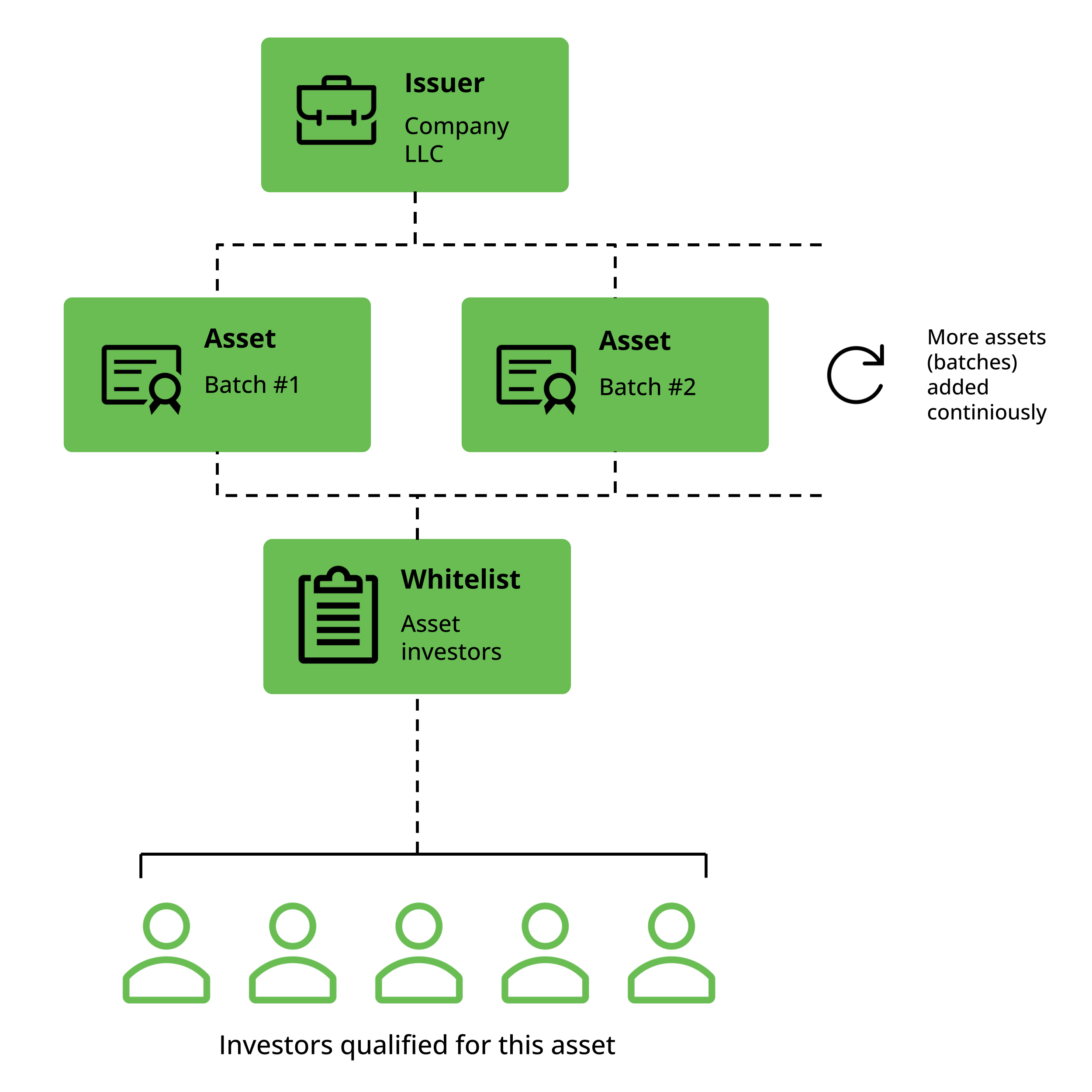
**When to use:** You regularly produce batches of the same product and need working capital for each batch, such as annual wine vintages where each vintage represents a separate investment opportunity:
* Each production batch becomes its own asset
* Same investor criteria across all batches (same risk profile and investor type)
* Investors participate in specific batches and receive returns tied to that batch's performance
* Each batch has its own primary distribution period
{% columns %}
{% column width="33.33333333333333%" %}
{% endcolumn %}
{% column width="66.66666666666667%" %}
**Recommended setup:** One issuer, one asset per production batch, one whitelist shared across all batches. This allows the same pool of qualified investors to participate in whichever batches they choose, while keeping the economics of each batch separate.
{% endcolumn %}
{% endcolumns %}
## **Series issuance**
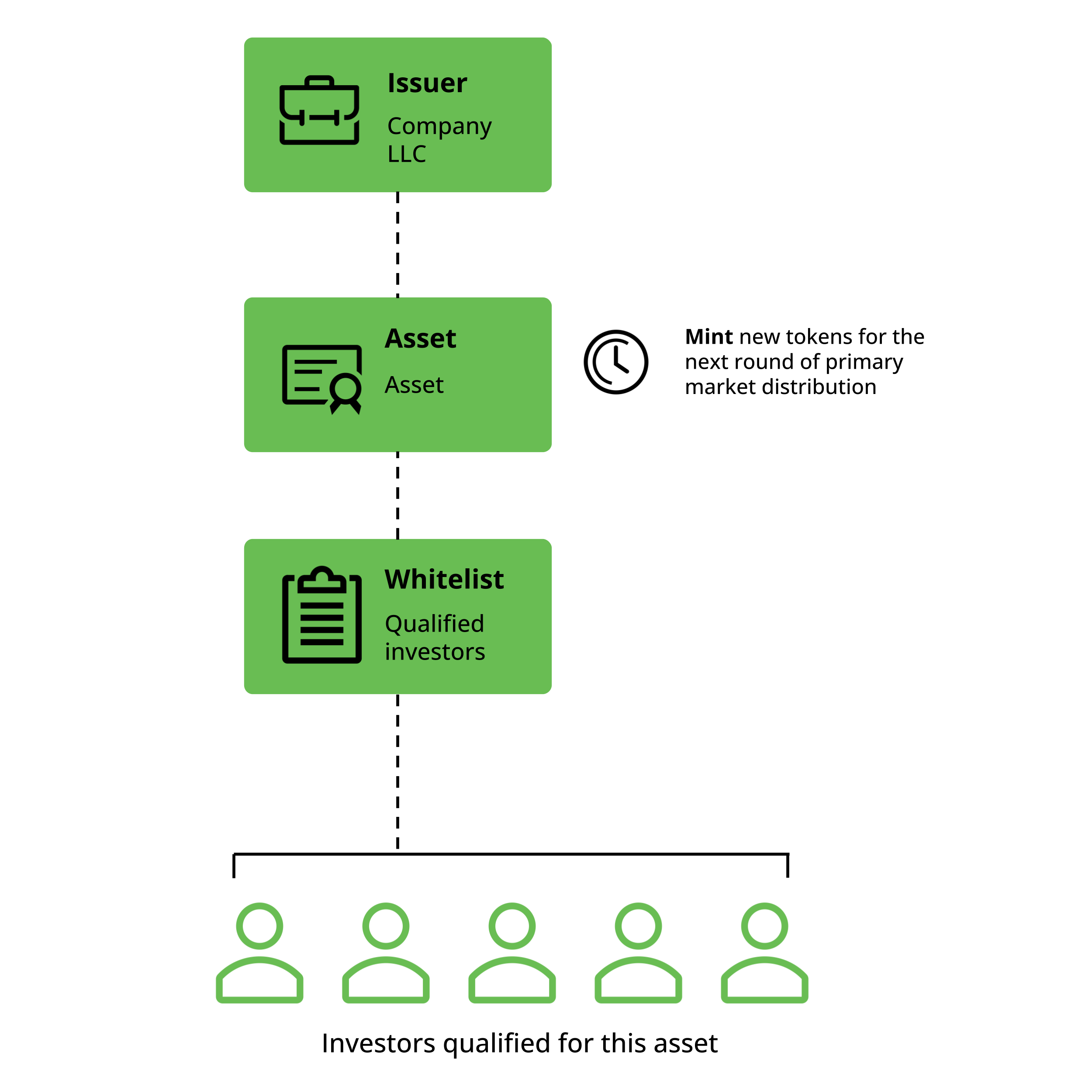
**When to use:** You're issuing tokens in multiple batches over time, such as expanding your equity share pool through multiple rounds:
* Same investor criteria across all batches
* Identical asset conditions (same class of shares, same rights, same profit sharing)
* Time-spaced primary market distributions to gradually increase total supply
{% columns %}
{% column width="33.33333333333333%" %}
{% endcolumn %}
{% column width="66.66666666666667%" %}
**Recommended setup:** One issuer, one asset, one whitelist. Mint new token batches as needed and proceed through the distribution process for each batch.
{% endcolumn %}
{% endcolumns %}